Wednesday, November 28, 2018

Hosting the Olympics: The Worst Investment in Sports for Nearly Every City


There is no world event that truly unites everyone like the Olympics. Although it is the second most-watched sporting events after the World Cup, over a hundred countries are represented. Both the Winter and Summer Olympics are televised across the globe and covered in dozens of languages, allowing those with access to be able to see the sports being played. Many cities put bids together every few years to host the Olympics, believing it will generate billions in revenue from tourism and jobs for people. But in fact, a seemingly guaranteed economy booster may be a bigger burden than one may think, and the true cost/benefit analysis that comes with looking at the Olympics makes one question why any city would host.

The cost to even make a bid itself costs a fortune. Cities will spend anywhere from $50 to $100 million in consulting and development fees to plan out how they will run the Olympics before they're even selected to host. Tokyo lost their 2016 bid and spent $150 million, but were able to win the 2020 Olympics with $75 million spent in that bid. Many countries will back out during the bidding phase itself because they drastically underestimate the costs, like Oslo and Stockholm as of recently.

Once a city wins the bid itself to host the Olympics, it will cost them billions to run the games themselves. Most recently, Rio spent over $20 billion on their Olympics, and Pyeongchang spent $12.9 billion on their games. This money is mainly used to build the infrastructure for the games. Whether that's new stadiums, roads, hotels, or more, many cities that don't have the preexisting infrastructure to run the Olympics will use their money to ensure the games can be run efficiently.

The games do have significant upsides. The roads can last for future events and reduce congestion in major cities. In Beijing in particular, the $11.25 billion in environmental clean up helped make the air quality better. Tourism can boom as a result of hosting, even after the games conclude, with more hotel rooms being built. Rio built 15,000 new hotel rooms as a result. Also, they can allow national sports teams in the future to have access to world-class facilities after the events conclude that winter or summer.

Yet, even with the upsides that the Olympics bring to cities, the cost/benefit analysis tilts almost exclusively in one direction. A single shocking goes above anything else in Olympic history: Los Angeles in 1984 is the only city that has ever received a profit from hosting. That's it. Every other city has been left with debt that taxpayers have paid over years, even three decades as with Montreal. Most of the profits made are gained by private industry and not the city. This means that for cities that have the majority of infrastructure to host, like LA, can see at the very least a net-neutral effect of hosting. Local congestion, unused stadiums, and lack of public support all also contribute to the drawbacks politically of having the Olympics.

While the prized Olympic Games are some of the most fun fans of any sports, of entertainment period, have, there is unfortunately nearly no upside long-term to hosting. And as time goes on, we will probably see fewer cities bid for the games because more are seeing the consequences of hosting these games. So, no matter how much a city may want to host, they must realize unless they are prepared with nearly all of the infrastructure, they best not host.

Sources:
https://www.investopedia.com/articles/markets-economy/092416/what-economic-impact-hosting-olympics.asp
https://www.economicshelp.org/blog/29/sport/costs-and-benefits-of-the-olympics/
https://www.forbes.com/sites/christinasettimi/2018/02/08/by-the-numbers-the-2018-pyeongchang-winter-olympics/#3dcf5ff47fb4

The NFL: No Guaranteed Contracts


There is more money in sports than ever before. From digital brand deals to merchandise to multi-billion dollar TV contracts and home game revenues, there is no shortage of money in pro sports. The NFL generates approximately $14 billion every single year, and it's increased its by 75% since 2010. And with so much money, you would think that players would be compensated fairly, compensated even more now with the league's incredible success. But, that is just not the case.

Out of the four major leagues in the US (NBA, MLB, NHL), the NFL is the only league that does not overwhelmingly guarantee contracts. This means that the money you sign on for, that deal that says you make $X million over Z years, does not actually mean you will make that total $X *Y amount. You pretty much make your money based on your signing bonuses, as well as any bonuses as the season goes on that are set by ownership and the GM. 

Economically, it makes nearly no sense to have non-guaranteed contracts in the NFL, especially for the players. No sport in the big four has the injury rate of the NFL. Players almost always play shorter careers in the NFL than anywhere else, and what's more, the actual post-playing consequences of the NFL are far greater, with CTE and chronic pain being a few of those results. Every single year that they can play effectively, they need to maximize the value of their careers before that time eventually passes. For the maybe eight to ten years the average good player has to make money, you would think that they would want and demand a guaranteed contract.

Unfortunately, because much of the NFL not giving players much of anything else like free agency until 1993, and have continued to fight about pensions, health insurance, and more, guaranteed contracts have unfortunately been turned to the wayside. Another substantial issue with the guaranteeing of contracts is that in the Collective Bargaining Agreement set by the NFLPA and NFL states that if a contract is guaranteed over any years, that money must be put into escrow, or into an other bank account. The salary cap imposed as a result of the free agency going into place also made owners care less about giving athletes guaranteed contracts.

A Harvard study found that just 44% of the money put in NFL contracts was actually written as guaranteed. And although this is almost two-fold increase from 12 years ago, it still does not actually give NFL players the chance to have their own skills to be valued as highly. Fortunately, as of late, some of the best players have begun to have outlined in their deals specific amounts guaranteed, where players like Aaron Rodgers is being guaranteed $100M of his $134M contract (75%!). Yet, with the sport's high injury rate, coupled with the NFLPA fighting far more important battles with the NFL, it appears as though guaranteed contracts will not be in the near future for players, even if the merits themselves are well-deserved. NFL players by all measures should receive guaranteed contracts, but until owners are pressured to make this a reality, there is little to no hope it will ever happen.

Sources:
https://deadspin.com/why-only-the-nfl-doesnt-guarantee-contracts-1797020799
https://www.usatoday.com/story/sports/nfl/2017/09/16/will-nfl-contracts-ever-fully-guarantee-players-can-hope/105676754/
https://www.cnbc.com/2018/08/30/aaron-rodgers-signs-134-million-nfl-contract-commits-to-green-bay.html

Economics of Bankruptcy

In the United States, there are several options for individuals or corporations who are unable to pay off their debts. The most common of these are chapter 7 and chapter 11 bankruptcy codes. Chapter 7 bankruptcy involves the liquidation of all non exempt assets. A firm would choose chapter 7 bankruptcy if their business model is not viable, meaning their marginal revenue is below average fixed costs. All the firms assets, such as machines and land, are sold and distributed among creditors. A firm would choose to file for chapter 11 bankruptcy if their business model is viable, but they are unable to pay off debts for some reason. With chapter 11 bankruptcy, unnecessary assets are liquidated. This could be a factory that is producing at a loss, or a surplus of workers that are causing a firms marginal revenue cost to be above its marginal revenue product. The firm then enters a contract with its creditors that allows the business to continue to operate, repaying its debts with any profits earned.

https://www.investopedia.com/ask/answers/differences-between-chapter-7-and-chapter-11/
https://money.howstuffworks.com/corporate-bankruptcy1.htm

Introduction to Monopsony


Last week we were introduced to the idea of a monopsony. By definition a monopsony is a market situation in which there is only one buyer. We see many examples of monopsonies in the real world. 

Labor productivity is run by industries and other people. They control the pay, the number of workers, how long they work and do what’s best in the interest of the company rather than the workers. The company will also look for certain skills or more versatile people so they can one person that can do many things rather than multiple people for each of those skills. A bigger company who can maintain a steady price will also be above those that would thrive in more competitive markets denies the access of goods to the consumer who are willing to pay the price above the cost of production but below the company’s price. Monopsonists can also move the market down so that the labor market goes down and so do the wages. Many examples of monopsony relate to the hiring of workers in relation to the labor market in which there is one company that is the sole purchaser of labor. This leads to stagnant wages because the employers can gain power and more revenue with the decrease of wages. Collusion can also drive down wages. Sometimes the salary earned don’t match what is needed for the cost of living at that time so the value of the money you have goes down in relation. So although your nominal wage increases, your real wage diminishes. 

Some examples of monopsony include school systems, Silicon Valley and Amazon. In school systems, teacher are the only employees and the school district are the only employers for the teacher. They control how many teachers are needed and the wages the teacher should have based on their budget; which is different based on public or private, or location of the school. This could lead to problems on both sides if the teachers go on strike because of low wages, or if the school district decides to get rid of teacher and maybe try newer ways of teaching. Another example is Silicon Valley. Silicon Valley is known for it big industry of technologies. The bigger firms such as Apple and Google could get away with lower wages because there aren’t explorers outside the tech industry that require some of the skills that these worker have. There is no competition. One last example is Amazon. They control the price at which they charge for shipping companies such as Fedex and UPS. In cases like these Amazon become the dominant buyer of labor and can control their wages. 

A monopsony can be dangerous because it can lead to a loss of societal well being as low wages can’t cover the high cost of living. In addition, with those companies dominating the labor market, the absence of a raise in wages. For example low unemployment rates there will be other factors that could affect the policies within the company, such as Amazon.


Game Theory – All in a Game

In Oligopoly, a company’s earning is affected not only by its own action but also by other major producers in the market.  When there are only a few companies dominating the entire market, it is possible to apply Game Theory (per Wikipedia, Game Theory is the study of mathematical models of strategic interaction between rational decision-makers) to determine the best action the company should take to maximize outcome, given the anticipated response from the competitor.
Coke and Pepsi are an example of Oligopoly, where each company work very hard to anticipate competitor response using Game Theory models before taking action.  So Coke and Pepsi are like two players playing a chess game, win and lose is all in a game.

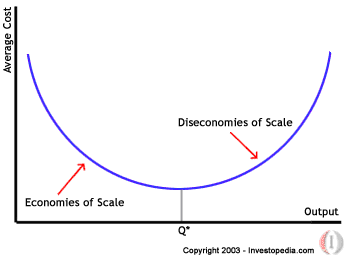
Diseconomies of Scale

    First off lets start off with economies of scale. Economies of scale is when a firm is able to decrease the cost of each unit produced while still increasing their output of the product. This means that their MC decrease while output increases. This can happen when say a product that used to be "homemade" gets moved to a factory where they can mass produce that product. Just like people in the industrial era realized, you can reduce costs while increasing output by doing this.
    On the other hand, you have diseconomies of scale. Diseconomies of scale is basically the opposite of economies of scale, where the cost of each unit produced increase while their output increases. In this case, MC increase while output increases. Something like this can happen in something like the previous example, where instead of moving from a home to a factory, the factory owners try to fit too many workers inside of the factory to try to increase produce. But, instead of increasing production, the workers start to get in each other's way, thus the factory starts to have to hire more workers to get the same increase in production that he did before, increasing MC.
    An example of diseconomies of scale is in mining. The mining industry tried to outputs in response to rising prices, but instead, they caused a diseconomy of scale. In order to try to increase their output, the mining industry tried to increase the size of their mines. However, in order to increase in size, they also needed to upgrade their existing structures. This upgrade in structures actually made them more complex, making it harder to use for their existing employees and decreasing the efficiency of the mine.

Tuesday, November 27, 2018

Is Amazon a Monopoly in the Eyes of Antitust Enforcement?

There is an ongoing debate as to whether or not Amazon is a monopoly. In the context of antitrust laws, a monopoly can stop a company from forming and dominate the market in such a way that competition is impossible. Antitrust enforcement regulates companies which they suspect are monopolies when they notice consumers are either maying more or have less choice.

Since Amazon offers its customers lower prices it is not considered a monopoly by antitrust laws and is a benefit to consumer welfare. A concept closely tied to monopolies is predatory pricing, which is when a company prices a good below cost to drive out its competitors so that the company is able to enjoy a dominant place in the market. Amazon displays predatory pricing technique with their willingness to sustain sufficient losses in the market. This is why some characterize the company’s business model as a threat to customers. However, it is hard for the government to follow through with predatory pricing investigations due to difficulty in proving cases.

To those who do indeed think Amazon is a monopoly, the government view of predatory pricing is outdated. There is a winner takes all marketplace found with tech companies: they attempt to gain as many users as possible at their earliest stages and once they have a lot, it becomes harder for competitors to attract them. It is in a situation such as this, that predatory pricing becomes more acceptable.

Another factor playing into Amazon’s portrayal of a monopoly is its expansiveness as a business. The company plays several roles in the market: an online retailer, content provider, book publisher, and maintains a vast network service. The company’s involvement in various lines of business is problematic because it can assert its dominance online to benefit its other lines.

While there is still discussion on whether or not Amazon is a monopoly, there is no doubt that the company is flourishing. As a provider service, Amazon has fundamentally managed to use the bargaining leverage of its users to lower costs as much as possible and appease to consumers.

Namibia's Economy

Namibia is a country that not many people think about. It is a small nation, right above South Africa, that bases most of its economy on to...